May 7, 2026
Marketing measurement has matured over 15 years, but it's not getting easier. Fragmented platforms, tightening privacy rules, and the rise of AI are creating new blind spots — and demanding a different kind of rigor from the people trying to make sense of it all.
Fifteen years ago, no one knew what to do with a Facebook "like." That wasn't a failure of imagination. It was the starting point for an entire discipline.
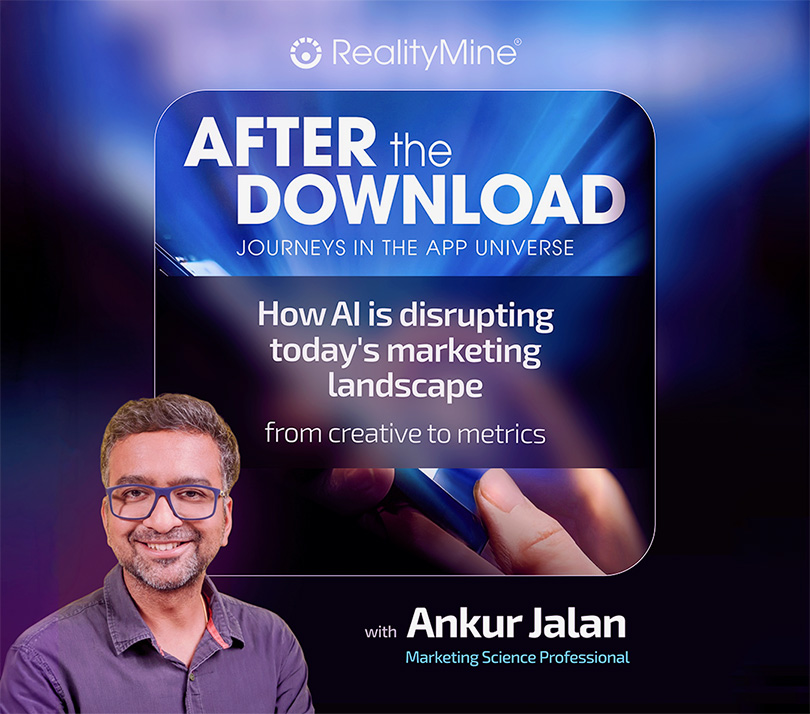
Marketing science — the practice of finding signal in the growing chaos of marketing data — grew up alongside the platforms. It was always part measurement, part art. As Ankur Jalan, a freelance marketing scientist with experience at Facebook, Snapchat, and Discord, puts it: "It requires expertise on both sides of the equation."
In Episode 4 of After the Download, Chris Havemann from RealityMine® sat down with Ankur to work through where the discipline stands today. The conversation covered creative, measurement, platform dynamics, the arrival of LLMs, and the structural problems that even well-resourced advertisers keep running into.
Here's what stood out.
The first era of marketing science was about figuring out how to measure at all. That problem is largely solved. Advertisers know what metrics matter and which platforms play what role in the funnel.
The second era is harder. Cross-platform attribution is increasingly difficult as walled gardens deepen and privacy regulations limit what can be tracked. Even incrementality measurement — once considered the gold standard — has "some sort of modeled-ness built into it by definition," as Ankur puts it, largely because of Apple's App Tracking Transparency framework.
The result: methods that felt like progress — last-click attribution, conversion lift tests — now have limits that marketers are only beginning to reckon with seriously. Marketing mix models, the methodology Ankur started his career with in 2010, are back in fashion. "Someone said MMM is the new thing," he notes, "and I was like — that's also the old thing."
It's not regression. It's recognition that no single source of truth exists, and that the industry needs to get comfortable operating without one.
Asked to explain why some platforms command 80-90% of advertiser budgets while others fight over the rest, Ankur broke it down to three levers: attention, intent, and auction quality.
TikTok's strength is attention — time spent is high and the algorithm is exceptionally good at holding users. Google's strength is intent — search, YouTube, and its broader ecosystem give advertisers direct access to what consumers are actively looking for. Meta's strength is auction quality — years of engineering culture built around fast iteration and continuous optimization have produced a system most competitors are still struggling to replicate.
Most platforms that have tried to build ad businesses without excelling at at least one of these have found themselves competing for the 10-20% of budgets that get allocated for diversification reasons rather than performance. "To get out of that," Ankur says, "you need to build really good systems that can infer intent — which is hard, especially in a world where getting those signals is very, very hard."
The most immediate impact of AI on the advertising industry, in Ankur's view, is on creative production. Tools can now generate thousands of variants, test them at speed, and iterate continuously. Platforms like Smartly are building on this. The large tech platforms are building creative automation directly into their products.
The paradox: the easier it becomes to produce creative at volume, the more valuable the person who knows how to make something that stands out.
"We'll get to a point where there is this whole creative explosion with a lot of substandard creatives," Ankur says. "And then brands will really need someone who can break through that clutter. Creative directors will have all the more value because things will get so cluttered."
It's visible already, he notes, in the way so much LinkedIn content now reads the same — same sentence structures, same hyphenated fragments, same pattern. Volume without judgment produces noise. The creative idea and the creative execution are different things, and AI currently handles one of them.
The arrival of ChatGPT and other LLMs has started reshaping how consumers navigate decision-making. Ankur's own behavior has shifted: for holiday planning, his first stop is now ChatGPT, not TripAdvisor or Booking.com. He still cross-references, but the starting point has changed.
For advertisers, this represents a structural shift that most are still treating as a distant problem. "Advertisers have not started thinking about it too much just yet," Ankur says. "Also because there's very little you can do about it as an advertiser at the moment."
That window is probably short. His expectation is that within one to two years, something equivalent to search engine optimization will emerge for AI systems. But the challenge is different from SEO — machine learning models don't produce transparent rankings, and the optimization playbook doesn't translate directly.
The deeper issue is the one Google has been quietly sitting with since ChatGPT launched. Search gave consumers a list of ten results and a choice. An AI assistant gives you one answer. "How do you even monetize that lack of choice?" Ankur asks. It's a question the industry doesn't have a clean answer to yet.
One of the sharpest observations in the conversation had nothing to do with platforms or AI. It was about org design.
Measurement teams that report into marketing functions are, by Ankur's account, structurally compromised. Their job becomes making media look good rather than finding truth. For advertisers who want to make decisions that aren't biased toward justifying existing spend, the measurement function needs to be genuinely neutral — sitting outside the channel team, not reporting into it.
"Advertisers need to make sure they are not flying blind, and that they have eyes and ears open," he says. "For that, they need to have a measurement or analytics team that is very, very neutral to the channel of investment."
It's unglamorous advice. But in a market where 80-90% of budgets go to two platforms anyway, the marginal value of getting the measurement right is significant.
Measurement is harder now than it was five years ago, not easier. Privacy restrictions and walled gardens have narrowed what's measurable with precision. Marketers who built their understanding of ROI on last-click attribution or straightforward conversion lifts need new mental models.
AI is a creative accelerant, not a creative replacement. The explosion of generative content will increase the value of judgment, not diminish it. The brands that come out ahead will be the ones that use AI to execute a strong idea faster, not to substitute for having one.
LLM-driven discovery is an emerging risk to search-dependent strategies. The shift is early but directional. The time to start thinking about how your brand shows up in AI-generated responses is before the optimization playbook exists, not after.
Neutral measurement matters more than ever. If the team responsible for telling you whether your media is working reports into marketing, the answer will tend to be yes. That's not useful.


Featured