Why app teams are struggling to grow, and what they’re missing
April 30, 2026

As AI reshapes discovery and accelerates competition, app teams are increasingly making growth decisions without visibility into how users really behave across competing apps. Understanding how your users interact with an increasingly complex and competitive digital landscape is now a core requirement for growth.
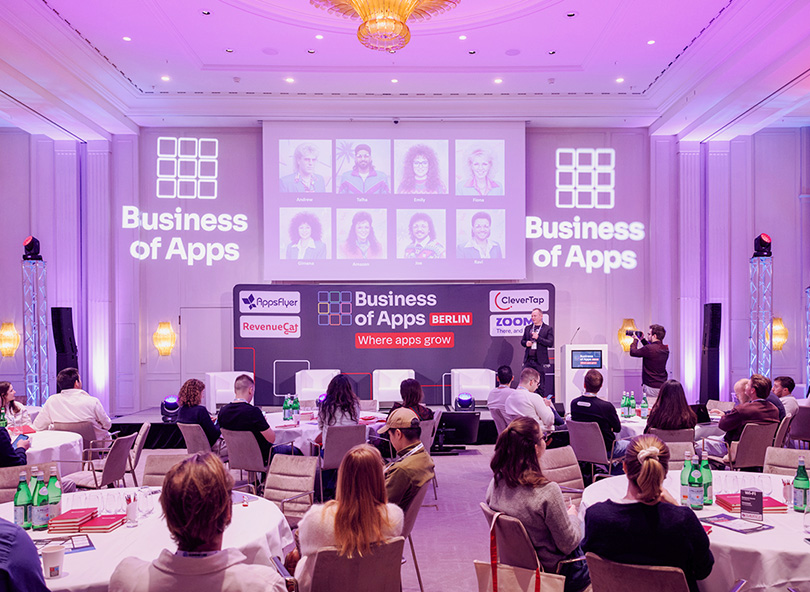
At Business of Apps London last week, one line from a presentation by Yodel Mobile cut through the noise: "AI ate my funnel."
It landed because it felt true.
The traditional app growth model had a shape: awareness, discovery, download, onboarding, retention. AI has disrupted that shape. Discovery now happens inside AI assistants, recommendation surfaces, and ambient suggestion engines that app platforms don't own and can't directly measure. The line between a user becoming aware of your app and becoming a customer is collapsing.
At the same conference, there was broad consensus on two things: growing a platform is hard, and it's getting harder. This article breaks down why.
For years, app marketers have known that personalized messaging improves conversion. The problem raised repeatedly at Business of Apps is that personalization alone is no longer sufficient — and scaling it isn't getting easier.
AI tools can help generate more targeted campaigns. But if you don't understand how your users behave outside your app, you're personalizing against an incomplete picture.
You know what someone did in your app. You don't know what they did before they opened it, what they did after they closed it, or which competitors or third-party platforms they visited in between.
That's not a messaging problem. That's a visibility problem — and it's one that first-party analytics, however sophisticated, can't solve on their own.
In categories like food delivery, where three or four platforms compete directly for the same users and the same wallet, that visibility gap is particularly costly. Retention metrics can look stable while category share is quietly shifting. You won't see it in your own data until it's already moved.
Across the event, the same pressures came up again:
These challenges can be solved by understanding how value moves across your category — not through surveys or modeled data, but through observed, real-world event-level user data across platforms.
It answers the questions that first-party analytics can't:
At Business of Apps, conversations kept returning to a specific version of this problem: understanding not just why users churn, but what they do after they leave. The keynote session featuring Ben Lebus, CEO and founder of Mob, illustrated this clearly. His team could see when users stopped showing up. They couldn't see where those users went or what triggered the exit. That gap — between knowing someone left and understanding why — is the heart of the churn intelligence problem.
Session-level data came up frequently as the currency that makes this kind of analysis possible: the record of what a user actually did, tap by tap, session by session, across every app they use.
One of the more striking observations at the event: AI is dramatically reducing the cost of app development. A competitor that would have taken 18 months and a full engineering team to build can now reach market significantly faster.
That's a different kind of competitive pressure. The competitive set for any established app is no longer just the known players. New entrants can appear quickly, acquire users aggressively on launch, and either fade or stick — and you may not see them coming until they've already made an impact on your numbers.
Retention strategy built only on internal engagement data can't see this coming. Cross-app intelligence that spans the full category — tracking user behavior across emerging and established apps alike — gives platforms earlier warning of these shifts.
Perhaps the biggest structural shift discussed at Business of Apps: LLMs and AI assistants are increasingly collapsing the distance between discovery and action.
Users are asking AI assistants what to do, what to buy, where to order from, not just browsing app stores or clicking ads anymore. Increasingly, discovery and decision-making are happening in the same moment, on surfaces that app teams don’t own.
They ask an AI assistant what to order for dinner, and the assistant can complete the transaction without ever routing them through an app store. Discovery and conversion happen in a single interaction; on a surface the app platform doesn't control and can't measure with first-party tools.
You need visibility into how AI-mediated surfaces are reshaping user journeys upstream — which categories they're affecting, which platforms are benefiting, and which are being quietly bypassed.
The cost of partial visibility used to be manageable. When discovery was more linear and the competitive set was stable, gaps in your data were gaps you could reason around.
That's no longer true. AI is compressing the time between a competitor making a move and that move affecting your numbers. A new incentive structure, a feature update, a change in how an AI assistant surfaces your category — any of these can start shifting user behavior before it registers anywhere in your internal metrics.
By the time the impact shows up in your retention cohorts or your CAC trends, it's already happened. You're not seeing a problem forming — you're seeing the result of one.
The answer isn't more internal data. Most app teams already have sophisticated first-party analytics. What's missing is visibility into what happens outside their ecosystem — how users move across competing apps, what pulls them away, and where they go when they leave.
That means observed, real-world behavioral data that captures the full picture of how users actually behave across a category — not modeled, not surveyed, not inferred from what happens inside a single platform.
You cannot grow an app by optimizing what you can see. You need to understand what you can’t.
As AI continues to reshape discovery, compress journeys, and accelerate competition, that external visibility becomes more important — not less. The teams that will navigate this period well are those that can connect what happens inside their app with what users are doing across the rest of their digital world.
Those that don’t will remain reactive — and in a market moving this quickly, that's an increasingly expensive place to be.


Featured