Key takeaways from Business of Apps Berlin
December 9, 2025
Consumer app growth in 2026 depends on behavioral segmentation, not demographics. Across Q-commerce, OTAs, and mobile gaming, leading apps are shifting focus from acquisition to retention, using first-party behavioral data to understand user intent. But internal metrics aren't enough—competitive advantage now requires visibility into what users do outside your ecosystem. At Business of Apps Berlin, industry leaders revealed how cross-app behavior patterns, rapid user classification, and competitive intelligence are becoming essential for mobile app user acquisition, retention, and lifetime value optimization.
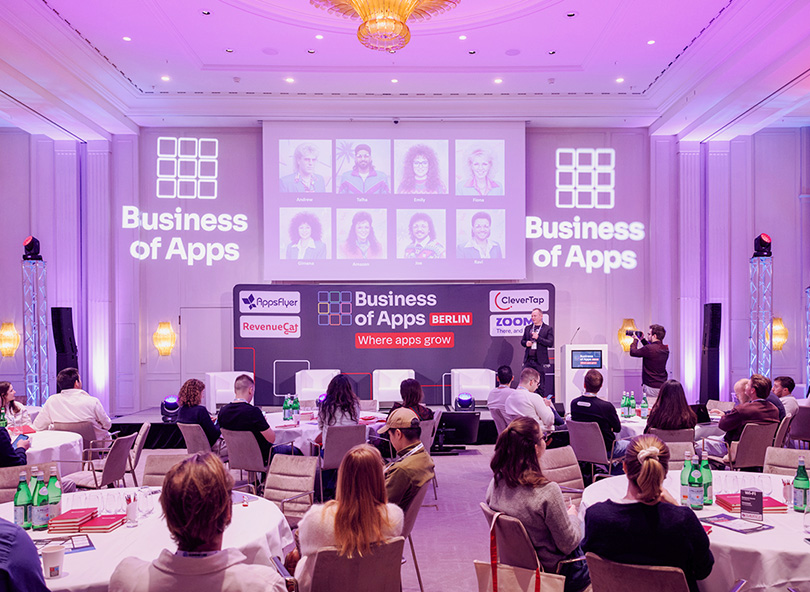
Business of Apps Berlin delivered what you want from a conference: sharp perspectives, candid conversations, and a city that makes even the tough topics feel energizing. From our RealityMine vantage point—working across big tech and the broader app economy—you start to recognize when the same challenges are surfacing everywhere at once. Berlin made that impossible to ignore.
Across Q-commerce, online travel, and mobile gaming, the themes were remarkably consistent: demographic targeting being no longer sufficient to predict intent, spiraling CAC and retention pressures, uncertainty over which product features still differentiate, and the accelerating impact of consumer-facing AI tools that blur traditional category boundaries. The message from leaders was clear: competitive advantage in 2026 will come from an old truth — knowing your customers intimately, both inside and outside of your ecosystem.
The consumer app space is maturing, with retention now mattering more than acquisition and behavioral signals replacing demographic assumptions.
And what we heard in Berlin reinforced what we see every day in our work with major app teams: first-party data is powerful, but incomplete. The real question every leader is wrestling with is “What happens outside our ecosystem—and how do we pull users back in?” Apps don’t win on internal metrics alone anymore. They win through context: understanding their market, their competitors, and their users’ true journeys across apps.
Because in 2026, knowing how your users behave matters.
Category growth does not ensure individual app growth. As Q-commerce, OTAs, and gaming expand, competition increases, CAC rises, and differentiation weakens. More choice means higher switching and lower retention stability.
First-party data also has limits. It shows in-app behavior, but not what users compare, explore, or adopt outside your ecosystem. Churn risk and competitive pressure often appear beyond your walls. In 2026, growth depends on understanding user behavior across the broader market, not just inside your app.
User segmentation is moving well beyond traditional demographic categories. A particularly strong presentation came from Flink, one of the few profitable players in Q-commerce. Their retention strategy focuses on behavioral profiling as a more reliable indicator of user value, rather than relying on age, location, or other surface-level attributes.
Flink runs entirely different app experiences for distinct behavioral segments.
The sophistication lies in their modeling. They visualize user segments internally as decision trees, mapping behavioral patterns to predicted outcomes. This isn’t personalization for aesthetics—their segmentation work directly drives growth in a sector where margins are razor-thin.
Flink quantifies the LTV of each segment based on:
This helps them identify high-potential customers who justify focused retention investment. The shift from demographic to behavioral profiling came up repeatedly throughout the conference. Demographics remain relevant, but they are baseline inputs.
Where segmentation breaks down is when internal behavioral signals are treated as complete truth. Models can miss early-stage users, external competitive exploration, or shifting intent that does not yet appear in-app. The real advantage comes from understanding why users behave as they do and predicting their next action, not just grouping them based on past activity.
Several presentations highlighted ongoing user acquisition cost challenges in thin-margin businesses. HelloFresh noted acquisition as central to their business model. Gaming companies discussed app store optimization and creative strategies extensively.
The more interesting insight emerged around what happens after acquisition. Flink’s success isn’t just about getting users through the door—it’s about rapid behavioral classification enabling the right experience from day one.
In thin-margin businesses, you cannot afford weeks of learning about a user through trial and error. Apps addressing this challenge find ways to:
Executives were not asking for more dashboards. What resonated most was the need to understand users quickly enough to drive growth. In a market where CAC is rising, the first sessions after acquisition matter most. If you misclassify a user early, you risk wasting acquisition spend or losing them before value is realized.
Leaders want strategic clarity:
These questions connect acquisition directly to retention. Faster behavioral classification improves CAC efficiency, strengthens early personalization, and increases the likelihood of long-term value. Traditional app analytics alone are not designed to answer these questions at the speed required in today’s market.
Across conversations about mobile user acquisition and retention, one theme surfaced repeatedly: companies are drowning in first-party data but starving for context. They know what users do inside their walls—but lack visibility into how that behavior fits into broader patterns:
This context gap becomes acute immediately after acquisition. Once you’ve acquired a user, how quickly can you determine who they are and their potential value? In businesses where acquisition is both challenging and expensive, you can’t spend weeks learning through trial and error while they form initial impressions of your app. Apps solving this are doing so not by collecting more data, but by adding critical context to existing data.
What outside-the-ecosystem signals actually show
Internal data shows what users do in your app. It does not show what they compare, explore, or switch to elsewhere.
Outside-the-ecosystem signals reveal:
These signals make competitive pressure measurable instead of reactive.
One conversation about online travel agency strategy proved particularly sobering. The OTA landscape has been relatively stable—similar tooling, similar approaches, differentiation mainly through inventory and pricing. Then large language models arrived.
A significant portion of users now start travel planning in AI assistants such as ChatGPT rather than going directly to booking platforms. They may not complete transactions through these tools yet, but the trajectory is clear – it’s coming. Major OTAs have responded predictably: building in-platform AI features to prevent user departure.
The strategic challenge exceeds adding AI capabilities. When competition expands beyond traditional category boundaries, the rules change. You’re no longer just competing on features or user experience—you’re competing for where users initially turn to solve problems.
This pattern extends beyond travel:
Understanding behavior beyond your analytics dashboard becomes critical.
Leaders recognize that competitive threat, churn risk, and lifetime value cannot be measured only through in-app behavior. As discussed across OTAs, gaming, and Q-commerce, user journeys increasingly begin outside traditional category apps, often in AI assistants, social platforms, or competing services.
Category growth does not limit competition to direct peers. It expands the number of entry points where user intent forms.
To understand competitive pressure, organizations need visibility into:
Because what users do before and after they engage with your app determines who wins their attention and loyalty.
Across conversations, a clear shift emerged—from execution-focused thinking to strategic decision-making. Optimizing funnels and improving creative still matter, but competitive advantage increasingly comes from making smarter decisions faster.
Key strategic questions for 2026 include:
These questions aren't answerable through A/B tests alone. Success demands comprehensive insights into user behavior, competitive dynamics, and cross-category patterns at a deeper level.
Understanding what drives true engagement, what signals emerging risks, and what creates lasting value requires seeing beyond your own walls.
As discussed across Q-commerce, OTAs, and gaming, growth challenges are no longer about basic execution. They stem from strategic blind spots.
Consumer app growth strategies in 2026 center on three interconnected shifts. First, behavioral segmentation is replacing demographic targeting as the foundation for user retention and lifetime value optimization. Second, competition now extends beyond traditional categories, with AI assistants and cross-category apps competing for user attention. Third, mobile app user acquisition success depends on rapid behavioral classification—understanding new users within days, not weeks.
The winners won't be apps with the most first-party data. They'll be organizations making faster, smarter decisions because they understand the full picture of user behavior across the digital ecosystem, not just what happens inside their own walls. Whether you're in Q-commerce, OTAs, or mobile gaming, growth depends on moving beyond internal metrics to understand what actually drives consumer app user engagement across the complete journey.
Photo: Robert Lehmann / Business of Apps Berlin


Featured