Downloads and news stories only tell part of the story.
March 26, 2026

ChatGPT, or "Chat," has become synonymous with AI. In the same way that Google became synonymous with search, or Hoover with vacuums, the word has transcended the product. Since its release in late 2022, the chatbot sent shockwaves within tech and beyond, and present-day commentary on AI is either predicting a future utopia, or our imminent demise.
Amidst all of this are the actual users of AI. For many of us, it has become the first port of call to pull information from multiple sources in a succinct manner. ChatGPT has been my go-to, but in 2026 I've noticed my usage change, including branching out to other AI chatbots.
I'm not alone. Over the past year we've seen news stories create surges in app downloads, public feuds between CEOs play out in real time, and political controversy thrust AI companies into the spotlight. This fluid landscape leaves an opportunity to become the "go-to" consumer application, and it isn't going to be decided by having the best model. It will be decided by having the best product. Those two things aren't the same. The model is the intelligence under the hood. The product is everything the user actually touches: the interface, the features, how it fits into their workflow. Microsoft's Copilot can connect to almost any frontier model, including OpenAI's and Anthropic's, and yet people aren't flocking to it because the experience doesn't stick. The model matters, but it's the product that earns the habit.
Who is going to win? That's a tough question, and one that may not be answered for years, with the spoils likely shared between a few victors. What we can discover and define clearly is who is winning right now, and how we judge that with data beyond downloads and news stories.
So, what else could we be looking at?
Three major events have shaped the consumer AI narrative in early 2026, and each one played out loudly in the press.
Google launched Gemini 3 in November 2025, followed by Gemini 3 Flash in December. Sundar Pichai announced that Gemini had surpassed 750 million monthly active users in Q4, up from 650 million the previous quarter. The model improvements drove a surge in Gemini downloads, but the real story is distribution: Gemini is baked into Android, Search, and the wider Google ecosystem. When your AI is pre-installed on a billion phones, adoption friction disappears entirely.
In February, Anthropic aired ads during the Super Bowl with the tagline "Ads are coming to AI. But not to Claude." It was a direct shot at OpenAI's announcement that they'd be introducing ads to ChatGPT. The spot was sharp, funny, and clearly hit a nerve. OpenAI CEO Sam Altman fired back publicly, calling the campaign "clearly dishonest." According to BNP Paribas analysis, Claude's daily active users jumped 11% post-game, the most significant increase amongst AI competitors they tracked.
Things escalated further at the end of February. Anthropic refused to allow Claude to be used for mass surveillance or autonomous weapons as part of a Pentagon contract. They lost the contract, followed by a government-wide ban on Anthropic products, and within hours OpenAI announced its own Pentagon deal. The public reaction was swift: ChatGPT uninstalls surged 295% in a single day, according to reporting from Storyboard18. Claude climbed to No.1 on the U.S. App Store, having sat at No. 131 at the end of January.
These are dramatic stories. But the news can be anecdotal, and people's opinions don't always reflect their behavior.
The wider AI chatbot market, of course, includes more than just these three. Perplexity, DeepSeek, Microsoft Copilot, and others are all carving out their own space. But the most interesting behavioral story right now is playing out between ChatGPT and Claude, and that's where our data takes us.
Using the RealityMine® passive behavioral measurement panel across iOS and Android, we tracked daily reach for both ChatGPT and Claude over the past year. The results broadly support the headlines, but the detail is more interesting, and in one important respect, the data tells a different story entirely.
The chart below tells the obvious story: ChatGPT's reach dwarfs Claude's. ChatGPT grew roughly 3x year-on-year, while Claude grew 25x, though from a much smaller base.
If you stopped here, you'd conclude this is a David and Goliath situation and move on. However, the chart below shows the biggest initial spike pre-dates both the Super Bowl and the Pentagon:
This is because Claude's growth wasn't a single event driven by one news cycle. It happened in three distinct phases.
The first phase coincides with the launch of Cowork, Anthropic's desktop product that extends Claude Code's agentic capabilities to non-technical users, on January 12th. This wasn't a news event most consumers would have noticed. It was a product release aimed at power users. Cowork itself is desktop-only, so it wouldn't show up directly in our mobile panel data. But what we may be seeing is the downstream effect: as more people started using Claude on desktop for work, that familiarity carried over into mobile usage in their personal lives. My assumption is that the tech-savvy amongst us, people who already knew Claude and Claude Code from enterprise use, started reaching for it on their phones too.
The Super Bowl was the second stage. Anthropic's campaign brought broader awareness, and the public spat with Altman amplified it. The data shows a clear continued uptick in reach from this point.
Then the Pentagon dispute provided the third and most dramatic acceleration. Daily reach jumped 34% in the two weeks following February 28th, compared to just 3% for ChatGPT in the same period.
The insight the news missed: If you only looked at the Pentagon coverage, you'd think this was a single political event driving downloads. The data shows it was three compounding events, product, then brand, then politics, each building on the last. The foundation was laid six weeks before the headlines.
Here's where it gets more nuanced. Positive downloads and reach don't automatically translate to heavy, habitual use. And when you look at the engagement quality data, the picture becomes more complicated.
Claude's share of heavy users, those spending 30 minutes or more per day, grew 9x between April and December 2025. By the second half of the year, Claude was matching or surpassing ChatGPT's heavy-user proportion. For an app with a fraction of the reach, that's a remarkable finding.
But from January, the influx of new users diluted that. Look at the shift in the stacked bars: the proportion swings dramatically toward sub-5-minute sessions. This is the classic surge pattern. New users arrive, they try the product, but it's mostly experimental at this point. They're not migrating their daily workflow, they're kicking the tires.
ChatGPT's engagement distribution, by contrast, is more stable throughout. It doesn't have the growth story, but it has consistency. And consistency matters when you're trying to work out whether a product has genuinely embedded itself into people's lives.
The question this raises is whether these new Claude users will deepen their usage over time, or whether they were just tourists, popping in because they saw a headline and then returning to their usual habits.
The cross-app data offers a clue.
Our data supports the idea that people aren't switching between AI chatbots. They're adding more to their repertoire.
65% of Claude users also used ChatGPT in February, up from 42% a year ago. Claude is increasingly used alongside ChatGPT, not instead of it. The reverse adoption is present too, but the math tells the real story: even a 12x increase in Claude overlap still only translates to 3.7% of ChatGPT users also using Claude. That's how large the base disparity remains.
Nobody consciously switches search engines either. They just gradually start going somewhere else more often. The cross-app data suggests something similar could be happening here, slowly, and largely invisibly in the download stats.
This isn't a zero-sum game right now. Users are experimenting, diversifying, working out which tool does what best. Brand loyalty hasn't set in the way we might have assumed.
It's important we don't let high-level news stories and AI developments cloud our understanding of how this is really playing out. User behavior is the real show of support, and the real measure of product success. And that behavior is going to be less impacted by how good the model is, or what's happening in the news, than by what features are available and how they enable the user in the jobs they want to do.
Downloads and App Store rankings get the headlines, but they don't tell you whether a product has become part of someone's life. Download rankings measure intent. They tell you someone was curious enough to tap install. They don't tell you what happened next. Passive behavioral measurement, tracking what people actually do on their devices over time, does. These four metrics are where the real answers live:
With these metrics, you get a clearer view of whether users are actually going to these apps regularly, and whether they're staying. Remember, eyes on screen is the real competition here. When users spend more time chatting to their AI instead of scrolling videos, the rest of the market will pay attention.
The questions I want to start answering next: Why have users gone to ChatGPT over Claude, or any other chatbot? Are there certain categories of prompts where one app outperforms? Is it personal vs. business use? When does brand loyalty solidify, and what causes it?
At a high level, Anthropic has undeniably gained consumer visibility during this period. But the consumer story is only part of the picture. While the headlines focus on downloads and App Store rankings, Anthropic has been quietly winning where the money actually is: enterprise. According to Ramp's AI Index, nearly one in four businesses now pays for Anthropic, up from one in 25 a year ago, and Anthropic now wins around 70% of head-to-head matchups against OpenAI among first-time AI buyers. OpenAI appears to have noticed. In mid-March, the Wall Street Journal reported a major strategy shift to refocus around coding tools and enterprise customers. Fidji Simo, OpenAI's CEO of Applications, reportedly described Anthropic's enterprise success as a "wake-up call."
Ben Thompson at Stratechery has drawn a parallel here that I think is worth sitting with. As he put it, "Anthropic got it right by focusing almost entirely on the enterprise market: companies have a demonstrated willingness to pay for software that makes their employees more productive." On his Sharp Tech podcast, Thompson took this further, comparing it to how Microsoft won enterprise through productivity tools before that professional familiarity carried over into personal use. The PC in the office became the PC at home. The three phases of Claude's consumer growth we've seen in our data, starting with the desktop-to-mobile spillover from Cowork adopters, suggest something similar could already be in play.
Then there's the monetization question. Anthropic has committed to keeping Claude ad-free. Altman's counterargument, that OpenAI needs to bring AI to billions who can't afford subscriptions, is legitimate. But Anthropic's business model of enterprise contracts and paid subscriptions appears to be working, with revenue reportedly approaching $19B annualized run rate, up from $4B in mid-2025.
And then there's the stat that puts everything in perspective. A chart that has been doing the rounds on LinkedIn, originally created by Damian Player, visualizes the global population as a grid of 2,500 dots, where each dot represents 3.2 million people. The overwhelming majority of that grid is grey.
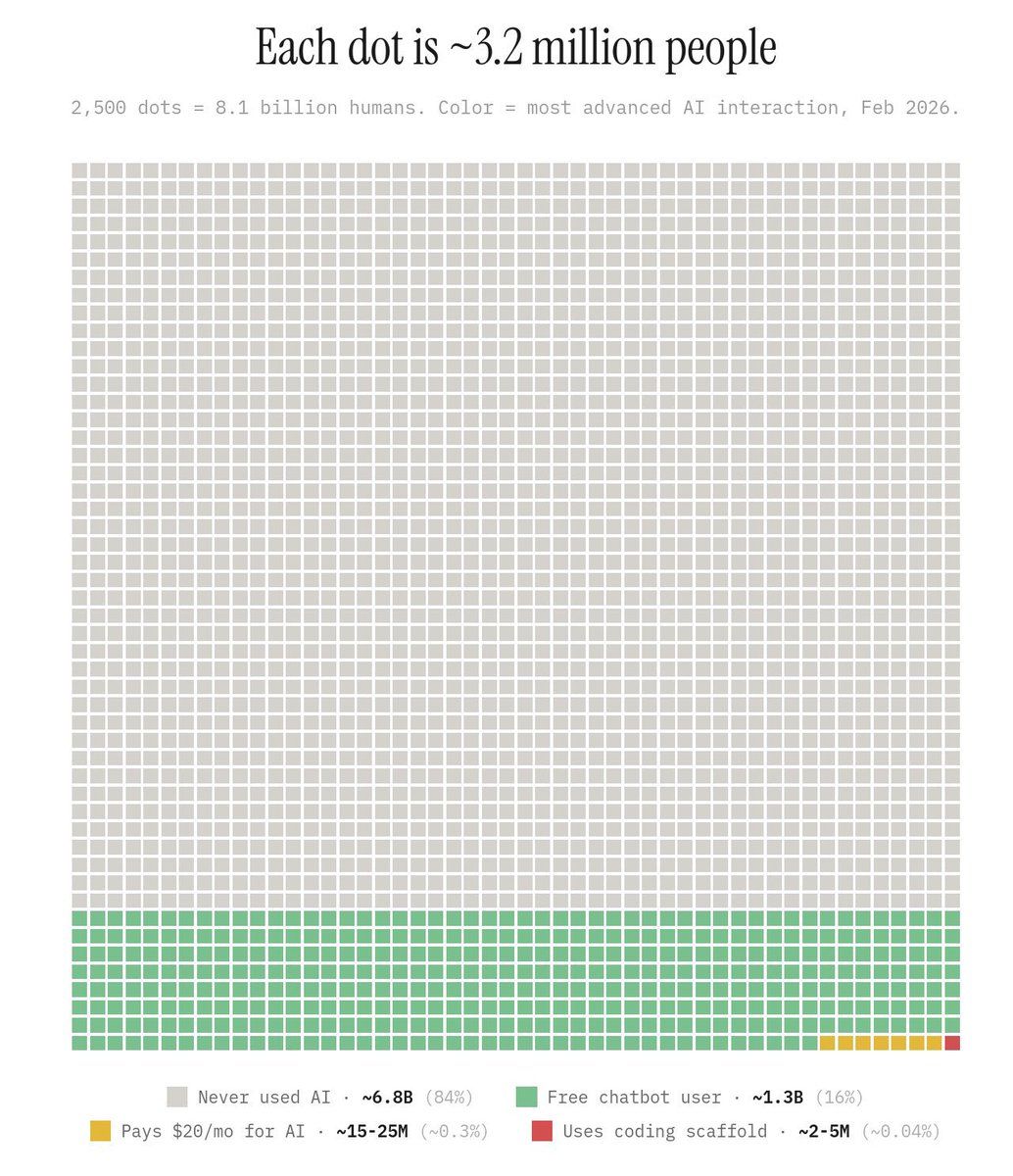
According to Microsoft's AI Economy Institute, only about 16% of the global working-age population uses generative AI tools. Roughly 84% have never typed a single prompt. Of those who have, the vast majority are on the free tier. There is still a huge market here to capture, and it isn't OpenAI's yet.
But here's the thing that should give the Pentagon-surge sceptics pause. Claude's consumer growth didn't start with a news cycle. It started with a product release. The biggest initial step-change in our data was Cowork in mid-January, not the Super Bowl, and not the Pentagon. The news amplified existing momentum, it didn't create it. Product-led growth tends to have more staying power than headline-driven spikes, and that's exactly what the engagement data from late 2025, when Claude's heavy-user share was matching ChatGPT's, suggests was already building.
The consumer AI race is ChatGPT's to lose. But the data shows it won't be lost to a viral moment or a political controversy. It'll be lost to a better product. And the only way to track that is to watch what people actually do, not what they download.

Craig Parker
Product Manager
Craig Parker is a Product Manager at RealityMine®, where he leads the development of mobile app and web measurement solutions. With over a decade of experience across project delivery, UX optimization, and data-driven SaaS products, he specializes in turning behavioral insights into strategic value. He’s especially interested in how emerging technologies like AI are reshaping user journeys across the app ecosystem.
Featured