August 27, 2026

Most AI-generated answers now end without a click, and tracking whether a brand or platform got cited in the answer only tells half the story. Citation shows presence. It says nothing about what the person did next — the layer that actually determines whether an AI answer changed anything.
AI brand monitoring — sometimes called AI visibility tracking — monitors whether, how, and how favorably a brand or platform appears in AI-generated answers, from search AI Overviews to chatbot responses. As zero-click search reshapes how people find information, it has become a fast-growing category in marketing technology.
But AI brand monitoring cannot show what happens after the AI-mediated moment. This article looks at the scale of the zero-click shift, why citation tracking alone is incomplete, what downstream behavior means in practice, and how platforms and brands can close the gap.
Zero-click search is no longer an edge case. In the first four months of 2026, 68.01% of US Google searches ended without a click through to a website, up from 60.45% in 2024 (SparkToro, June 2026). Nearly seven in ten searches now resolve entirely inside the search results page or an AI-generated answer.
Publisher referral traffic has fallen alongside it. Google organic search referrals to more than 2,500 publisher sites tracked by Chartbeat fell 33% globally between November 2024 and November 2025 — 38% in the US alone (Reuters Institute). The impact has been uneven: an Axios analysis of the same data found that small publishers lost 60% of their search referral traffic over two years, compared with 47% for medium publishers and 22% for large publishers.
This shift affects platforms too. When an AI-generated answer replaces a click, the platform controls more of the discovery journey — but loses one of the traditional signals of what the user did next.
The industry’s response has been a wave of new spend on tools that track whether a brand is mentioned or cited inside AI answers — AI brand monitoring platforms built to answer one question: are we visible in this new layer of discovery?
AI brand monitoring and AI-visibility platforms track mentions, citations, sentiment, and share of voice across AI-generated answers — surfacing whether a brand or platform is named, how favorably, and how often relative to competitors.
.png)
Picture a search platform that has just shipped a new AI Overview format. Its dashboards show strong citation, positive sentiment, and rising share of voice. But none can say whether the people reading those answers used the product, compared it elsewhere, or simply closed the tab. The mention data looks like success. It may or may not be.
That makes citation a useful measure of visibility, but an incomplete measure of impact.
Need to understand what happens after the AI answer? See how RealityMine® can reveal cross-platform behavior beyond your first-party view.
AI-mediated discovery can be understood as three layers, and most current monitoring only reaches the first.
Whether a brand or platform is mentioned, cited, or recommended inside an AI-generated answer — the layer AI brand monitoring tools already cover well.
What happens inside the AI session itself — follow-up questions, comparisons requested, whether the user asks for more detail before moving on.
What the person actually does afterward: which app they open, which site they visit, whether they buy, compare further, or drop off. Tracking what happens after an AI interaction can reveal how that journey continues across other apps and services — activity no single platform or brand can see on its own.
Recent RealityMine® data shows why the journey after an AI interaction matters. During Prime Day 2026, shoppers who moved directly from ChatGPT to Amazon converted at 17%, compared with 10% for TikTok, 8% for Google, and 7% for Facebook or YouTube.
ChatGPT-transitioning shoppers also spent more time on Amazon than shoppers arriving from other sources. And compared to ChatGPT-transitioning shoppers last year, this year’s group spent more time on Amazon and had a 68% higher median order value, the largest YoY increase of any source.
Differences in how AI-transitioned shoppers behave once they reached Amazon during Prime Day 2026:
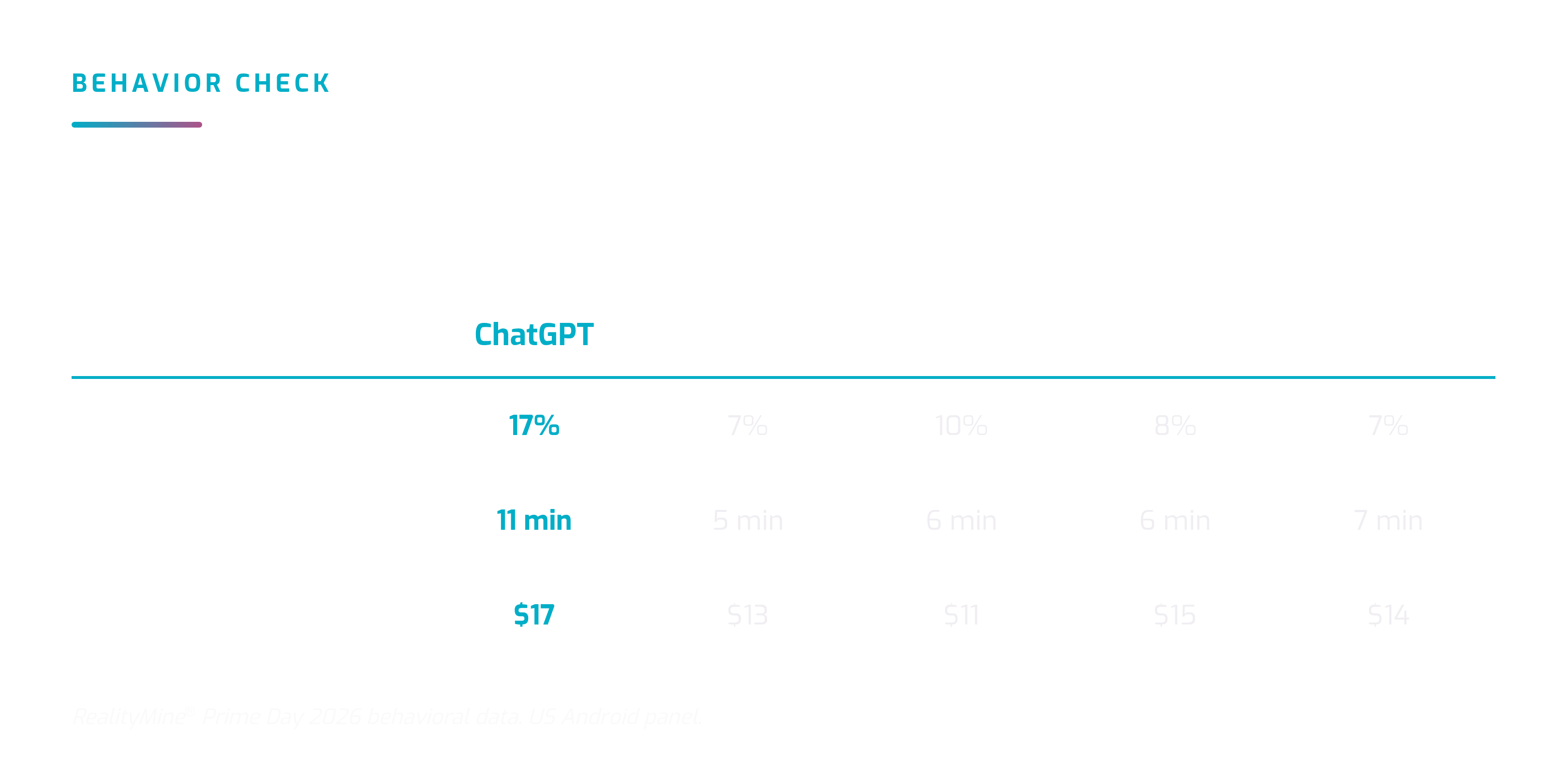
These findings don’t mean AI referrals are universally “better” traffic. Direct ChatGPT-to-Amazon journeys still represented only around 4% of Amazon users in the analysis. What they show is that the route into a platform can correspond with measurably different downstream behavior.
And none of this appears in citation or mention data. A brand could be highly visible inside an AI-generated answer without knowing whether that visibility led someone to visit, compare, buy, or do nothing at all.
Search, social, and discovery platforms now decide how AI answers get served, which puts them closest to both the opportunity and the blind spot.
Knowing whether an AI-generated answer served the user’s intent — or simply suppressed a click without producing an outcome — is a product decision as well as a measurement one. That insight can inform how answers are structured, when links are surfaced, and how AI experiences are optimized around real usage.
As referral traffic declines, platforms need new ways to demonstrate that AI-mediated discovery still creates value for the brands paying to be found. Downstream action — not citation counts alone — can help support the value of advertising and licensing in this environment.
Permissioned behavioral data can complement a platform’s own first-party analytics by showing what happens once a user leaves the platform’s ecosystem — closing the gap between what surveys and self-reported data suggest and what people actually do.
The same applies to brands trying to be found and chosen inside AI answers. Being mentioned is necessary, but not sufficient: without downstream behavior, a brand cannot tell whether strong AI visibility translated into traffic, app usage, comparison, or purchase. Citation should therefore be treated as one input into the bigger picture of how AI-shaped demand translates into real behavior — not the outcome itself.
Closing the loop means pairing visibility data with observed, cross-platform behavioral data showing what happens after the AI moment: which app opens next, which site gets visited, and whether the person buys, compares, or drops off. That becomes increasingly important as traditional attribution signals break down in AI-mediated discovery.
This is where RealityMine’s approach fits: permissioned, privacy-safe behavioral data capture across apps and the web, designed to reveal activity beyond a company’s own properties. It doesn’t claim to capture 100% of a journey — no single data source can — but it can address the blind spots that first-party analytics cannot see beyond their own walls.
As AI takes more of the discovery journey inside the answer itself, the signals marketers and platforms once relied on — clicks, referrals, and sessions — tell less of the story.
AI brand monitoring can show whether you were visible. The next question is whether that visibility changed anything.
Connecting citation and visibility data with downstream behavioral data completes that picture: from what the AI showed, to how the user engaged, to what they actually did next. That is the difference between documenting the shift to AI-mediated discovery and understanding its real impact.


Featured