September 10, 2026

Signal poverty occurs when an ad platform has enough outcome data to optimize its systems, but not enough to know how complete or representative that data is. Advertisers selectively forward conversion events, leaving much of the customer journey unseen. Better integrations can improve the data received, but they cannot recover events that were never reported.
An ad platform knows which ads it serves, but it may not know what happens afterwards.
Those outcomes depend on data reported by advertisers, who don’t send a complete record of everything their customers do. They choose which conversion events to forward, meaning the data available to an ad platform represents only part of the customer journey.
That creates a problem for the ranking and optimization models that rely on those outcomes. A conversion that was never reported can look exactly like one that never happened. In both cases, the platform sees no conversion.
Nothing necessarily looks wrong. Models continue to produce predictions, dashboards report performance and advertisers receive results. But all of them are working from the same incomplete outcome record, with no way to see how much is missing or whether those gaps are systematically skewing what the model learns.
We use signal poverty rather than signal loss because this is not a single event or technical change that caused data to disappear. It is a structural condition: ad platforms have enough outcome data to optimize against, but not enough independent data to know how complete or representative those outcomes are.
Event forwarding through measurement partners is typically metered. Advertisers therefore have little incentive to send every event they capture when the main benefit of that additional data accrues to the platform's ranking model. They are more likely to prioritize the events they optimize against.
Their own product analytics capture searches, product views, comparisons, cart changes, checkout abandonment and refunds. None of it is secret. It simply never leaves their side.
Pixels and conversion APIs can improve the reliability of selected events, but better implementation improves the pipe rather than what the advertiser decided to put through it. Changes to browser cookies and App Tracking Transparency have affected the amount of outcome data available to platforms. But neither created the underlying dependency on advertiser-reported events. Privacy changes can alter what is technically observable; they do not change the fact that advertisers decide which of their own events to forward.
Behind a single conversion sits a search, several alternatives viewed, a price compared in a second app, a cart abandoned, a purchase later. Depending on the advertiser’s setup, the platform receives the click and the purchase, or the click and an app open, or a delayed aggregated postback, or no matchable outcome at all.
Put side by side, the pattern is easy to see:
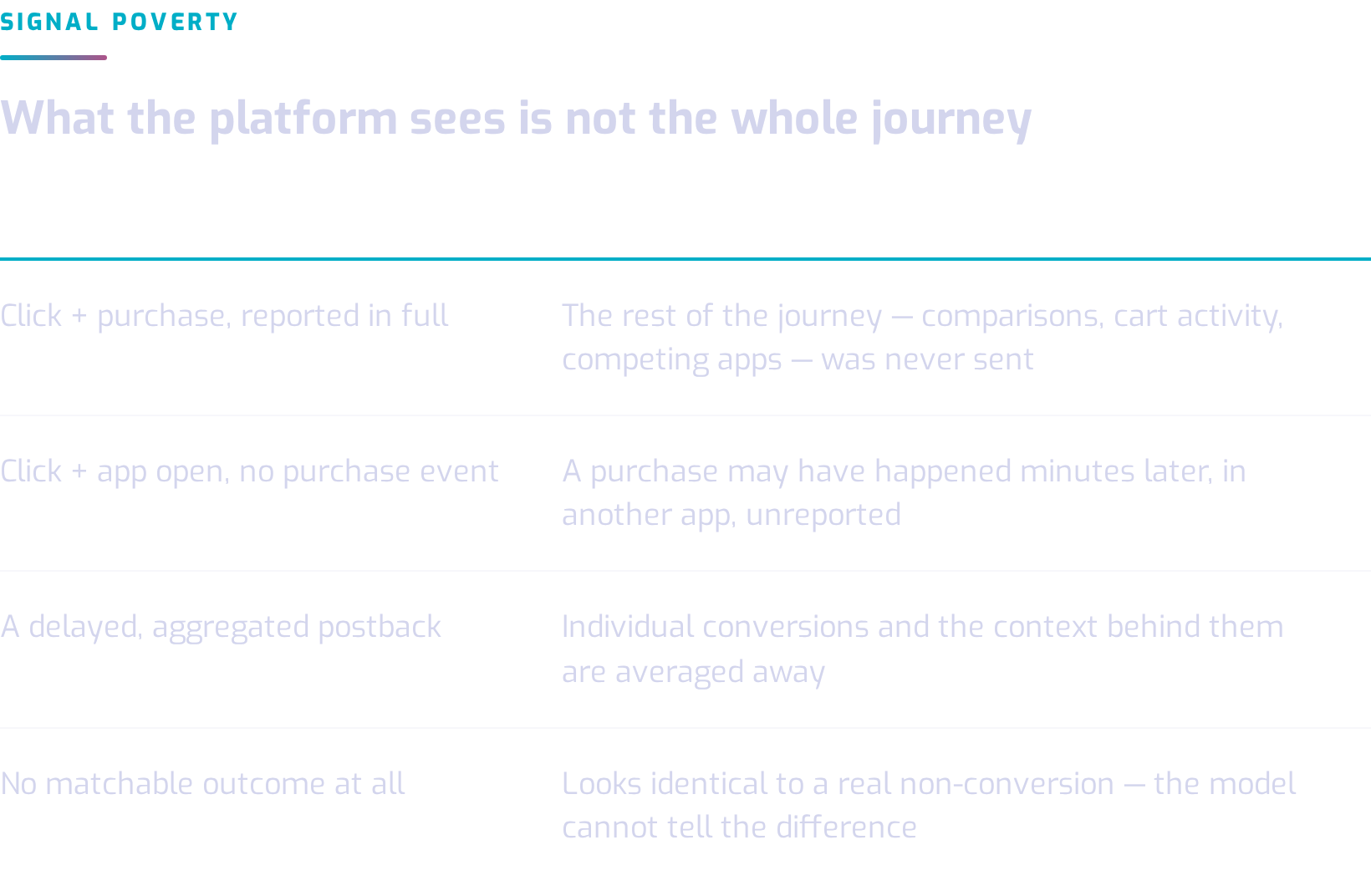
None of this is a flaw in any one advertiser’s integration — it is a boundary built into how outcome data reaches a platform at all.
Coverage also varies systematically rather than randomly. Some advertisers run mature server-side integrations while others return only a limited set of events. The result is not simply less data, but an outcome record that may over- or under-represent particular advertisers, markets or environments. The model sees the record it receives; it has no indication of how representative that record is.
That makes signal poverty a revenue problem as well as a measurement problem. Outcome data influences ranking quality; ranking quality affects advertiser performance; and performance influences where advertisers put their next budget. A platform working from a partial outcome record may therefore be making decisions about both ranking and inventory value without seeing the full results its advertising produced.
See how RealityMine® can help identify the behavioral signals missing from your platform-side data.
In August 2025, in the US, RealityMine® observed a shopper move between Walmart and Amazon five times in 22 minutes, viewing 16 products before buying one. The session opened on Walmart at 9:59 a.m. with searches for “LOL doll surprise clearance” and “blind bag clearance,” moved to Amazon, returned to Walmart for other mystery products, then switched back to Amazon for “popmart labubu” and “make it mini.” At 10:19 a.m. the shopper was back on Walmart looking at Magic Mixies Pixlings Deerlee at $20.62, and two minutes later bought Magic Mixies Faye the Fairy on Amazon for $17.99.
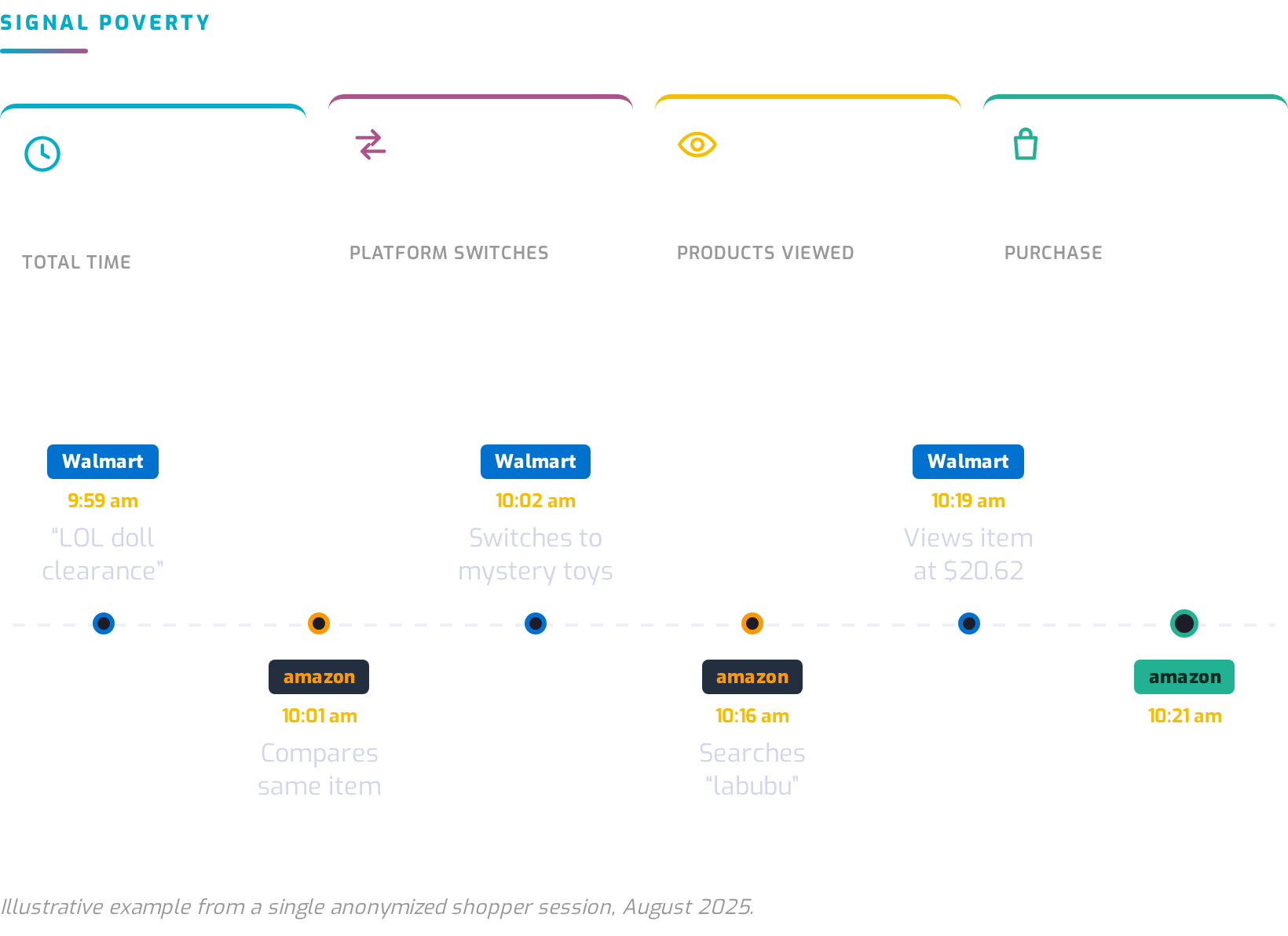
An ad platform receiving this conversion learns that a shopper bought a toy for $17.99.
One journey proves nothing about causation. What it shows is how much sits behind a single conversion event: the retailer comparison, the changing search terms, the products rejected, and a final choice made across two apps minutes apart.
If that purchase is forwarded, the platform learns the outcome and none of the sequence. If the purchase is not forwarded, the platform has no outcome from which to learn — regardless of everything that happened before it. At scale, incomplete journeys like this affect what a system learns about its own inventory: which impressions look worthwhile and which advertisers appear to perform well.
Ask a platform what share of its advertisers’ conversions actually reaches its ranking system, and the answer is rarely to hand.
The internal version of this conversation usually stalls in the same place. Everyone agrees the outcome record is incomplete. Nobody can put a number on how incomplete, or how those gaps may skew it, because answering that requires a source of outcomes the platform does not have. The missing information sits outside the environments the platform controls.
A large first-party data set does not solve the problem. It may provide a detailed record of what a user does within one ecosystem, but it cannot show what happened before or after that activity elsewhere. It is the platform-side version of the same blind spot RealityMine has written about for advertisers relying on first-party data alone.
RealityMine® captures consented, privacy-safe session-level behavior across apps and websites, within an agreed market and app scope.
Used as an independent reference set, it shows the searches, comparisons and outcomes that make up journeys beyond the platform's own view. Platforms can then compare the outcome record they receive with observed behavior outside their own systems — identifying where coverage is thin, which journeys are under-represented and where their models may be learning from an incomplete picture.
The question worth asking is not whether an ad platform has a lot of data. It is how much of the outcome record it ranks against it can actually account for.
That cannot be answered from inside the platform's own systems, because the missing outcomes were never there to begin with. An independent view of behavior outside those systems is what turns that unknown into something measurable — and shows whether the record used to rank, optimize and price advertising reflects what customers actually did.
RealityMine® builds bespoke behavioral data capture around the markets, apps and outcomes that matter to your platform.


Featured