

When messaging, content, and commerce become one
July 30, 2026

Messaging, content, commerce, search and AI are converging inside the same apps, so app categories are becoming a less reliable guide to behavior. For strategy and analytics teams, that means competitors and buying intent increasingly form outside the categories they track — and behavioral data, not app names, reveals it.
Users are increasingly being given ways to chat, browse, compare and buy inside the same app environments. As messaging, content, commerce, search and AI converge, fixed app categories are becoming less reliable. Super apps, or all-in-one platforms, are changing not only user experience, but how businesses understand customers, competitors and intent.
WeChat remains the best-known example of a super app, and many consumer platforms have learned from the convenience and commercial power of that model. But the more interesting shift is not simply that the western markets are trying to copy WeChat. It is that the logic of the super app is spreading across multiple platforms at once.
RealityMine® data shows why this matters. The typical U.S. consumer uses around 19 apps per day, interacts with their device 90 to 200 times per day, and spends nearly half of all mobile time in just five apps— a market that is both concentrated and fragmented. Knowing which apps people use is essential. Understanding what they are doing inside those apps becomes the next layer of insight.
This article covers:
A super app is a multi-service platform where users complete several tasks without moving between separate apps. Someone might message a business, discover a product, watch content, make a payment, and book a service inside one environment.
Historically, app categories made behavior easier to read. Netflix meant streaming. WhatsApp meant messaging. Google meant search. Amazon meant shopping. TikTok meant short-form video.
That shorthand is fading. TikTok can be entertainment, shopping, and travel discovery. WhatsApp can be messaging, customer service, and sales. Google can be search, comparison, and AI-led shopping. Retailers can be stores, advertising networks, and media platforms.
The important point is not that app usage data becomes less valuable. It is that the app name alone explains less than it used to.
The question for strategy and analytics teams changes from:
Which app did someone open?
To:
What were they trying to do once they got there?
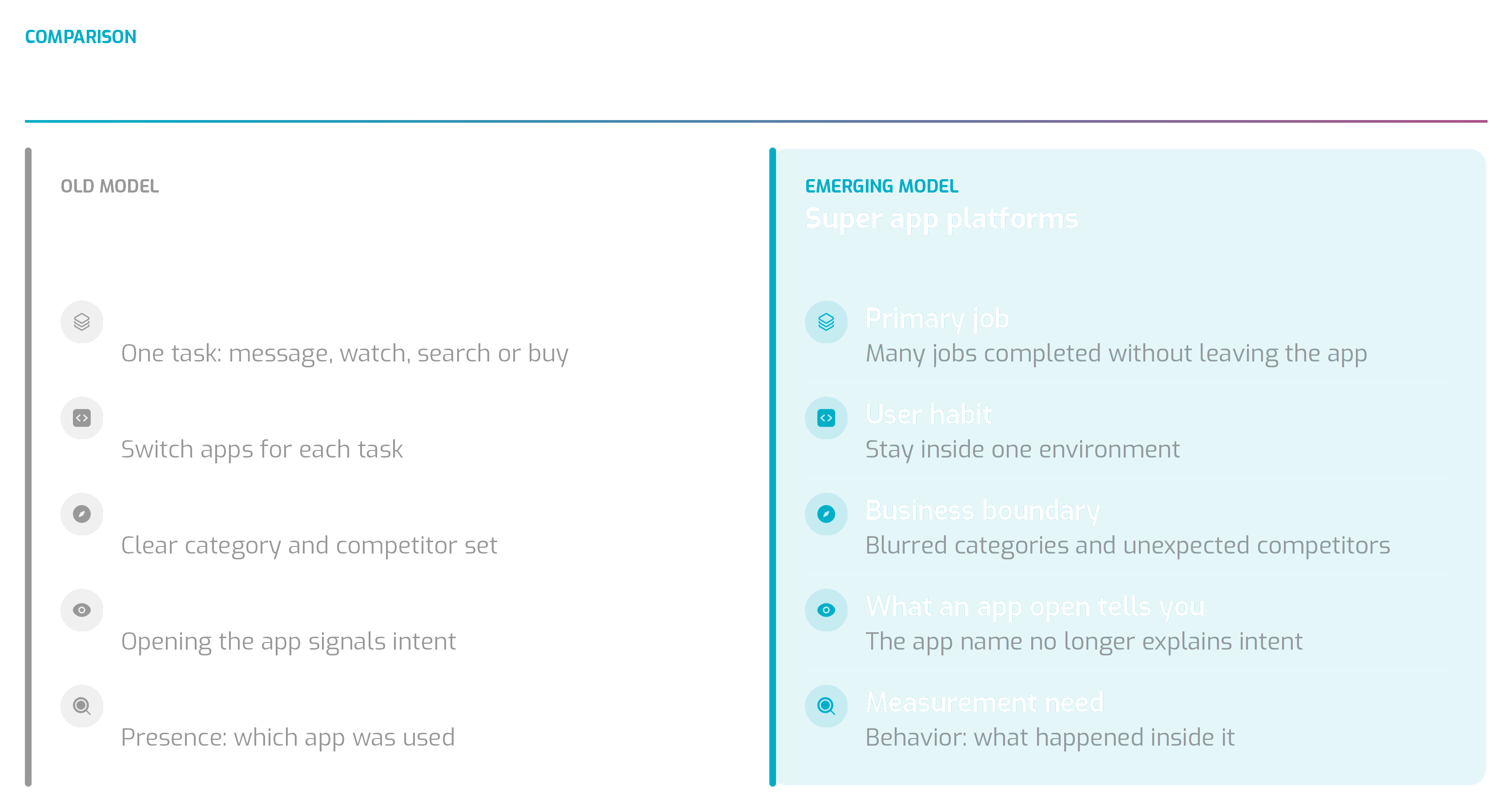
App convergence is being driven by several market and behavioral forces. As mobile apps converge around user habits rather than app-store categories, four drivers stand out.
The temptation is to treat all of this just as a product story. But it is also a market structure story. Platforms are not just adding features. They are trying to own more of the moments around a user’s intent.
The move towards multi-service apps is not just technical. It is commercial.
It is expensive to persuade users to download and regularly use a new app. It is easier to introduce a new behavior inside an app they already use. TikTok’s 2026 launch of TikTok GO, an in-app travel booking layer, is a useful example. It builds on existing attention, creator influence and discovery behavior rather than asking users to start from scratch in a travel app.
The more jobs a platform performs, the more reasons users have to return. Meta’s global rollout of its Business Agent across WhatsApp, Instagram and Messenger turns messaging into service, lead qualification, and sales. That makes the platform deliver more value than messaging alone.
Frequency compounds. The platform that owns everyday attention gets more chances to shape intent before a brand-owned app or website is opened. That is why Google extending search into AI-led shopping and agentic checkout matters as more than just a feature —it is an attempt to keep more of the decision inside Google’s environment.
That does not mean every platform expansion will work. Some will feel natural. Some will feel bolted on. The difference matters, because usersreward products for reducing friction in a moment that already matters, not for having more features.
App convergence usually happens gradually. A platform starts with one strong habit, builds a large and loyal user base, then expands into adjacent services that fit what users already come to do.
This is most common in categories with high-frequency use and established trust, such as messaging, content, commerce, payments and delivery. In those categories, a new service can feel like a natural extension.
The key test is fit. TikTok moving into shopping and travel, Meta moving deeper into business messaging, and retailers becoming media platforms all make sense because users, businesses and purchase intent already meet there.
Not every expansion succeeds. Adding features simply to become an all-in-one app can create clutter, confusion and trust issues. But when the fit is right, the app becomes less a single-purpose destination and more the infrastructure for a wider set of behaviors.
That is when the future of super apps starts to look less like a product feature and more like a shift in how demand forms.
This is where convergence becomes more than a user-experience story.
If platforms absorb behaviors from adjacent categories, traditional competitive sets lose value. A travel brand may watch other travel apps while destination intent starts on a content platform. A retailer may watch other retailers while product comparison happens in AI-led search. The next competitor may not announce itself as a competitor at first. It may appear as a recommendation, a creator video, a chat thread, an AI answer or a shoppable media placement.
Internal analytics and platform dashboards each show what happens inside their own walls. Both are valuable. Both have limits.
The gap is the movement between them.
That movement matters because the app name alone no longer explains intent. Opening a messaging app could mean chatting with a friend, contacting a business, or moving towards a purchase. Opening TikTok could mean watching entertainment, researching a product or discovering a travel destination.
Closing that gap requires observed session-level behavioral data that can complement modelled estimates and internal analytics, across apps, websites and devices.
Convergence is not guaranteed to be smooth, and treating it as inevitable is its own blind spot.
The point is not that every platform will become a super app. It is that enough platforms are moving this way to make fixed categories unreliable as the only lens on the market.
The practical response is not to discard existing measurement frameworks. It is to add a layer that sees across categories.
This is the part that should make analytics and strategy teams pause. Not because their existing data is wrong, but because it may be answering a narrower question than the market is now asking.
The old question was: how much time did people spend in this app?
The newer question is: what role did this app play in the journey?
Messaging, content, commerce, search and AI are merging into more unified experiences, and that makes fixed app categories a weaker guide to customer behavior. The shift is driven by changing user expectations, but also by platforms chasing deeper engagement, stronger retention and more influence over the moments where intent forms.
App and web data remains foundational. The challenge is that the meaning of an app session is changing. Strategy and analytics teams can no longer assume competitors will appear from inside the same category, or that intent will always begin inside owned channels.
As digital ecosystems keep evolving, the advantage goes to businesses that can see where users spend their time, what they are trying to do and where intent begins as those boundaries blur.
Don’t miss the converged platforms influencing customers before they arrive. See how users behave across the apps and websites you cannot track.

Craig Parker
Product Manager
Craig Parker is a Product Manager at RealityMine®, where he leads the development of mobile app and web measurement solutions. With over a decade of experience across project delivery, UX optimization, and data-driven SaaS products, he specializes in turning behavioral insights into strategic value. He’s especially interested in how emerging technologies like AI are reshaping user journeys across the app ecosystem.


