Debra Aho Williamson on retail media, platform competition, and advertising to AI agents
September 17, 2026
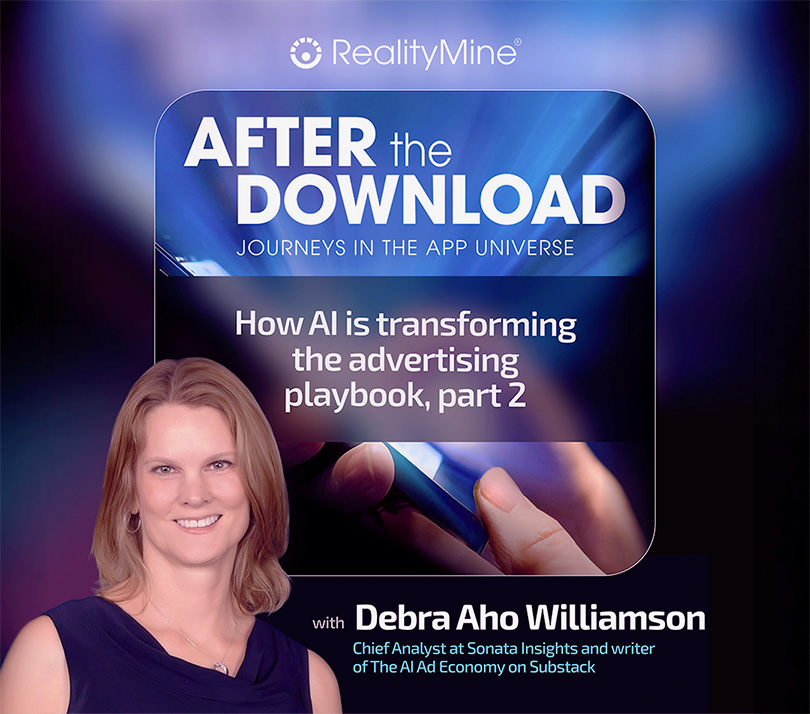
As consumers increasingly use AI to research products and make decisions, advertisers have new opportunities — and new blind spots — along the path to purchase. Analyst Debra Aho Williamson explains why retail is moving early, how AI conversations reveal richer intent, and what could change when consumers start delegating decisions to AI agents.
This is part two of a two-part conversation between RealityMine CEO Chris Havemann and analyst Debra Aho Williamson, founder and Chief Analyst at Sonata Insights and author of The AI Ad Economy on Substack. Part one covered why consumer trust doesn't predict AI adoption and how AI is compressing the path to purchase. Part two goes further: which advertisers should move first, how the fight for AI ad dollars is shaping up, and what happens once brands start marketing to agents instead of people.
Williamson spent 17 years at eMarketer tracking the rise of social platforms, and she's applying the same instincts — spotting which platform wins, and which categories move first — to the AI ad economy.
Here's what she told Chris about where the opportunity is landing first, and where it's headed next.
Williamson predicted retail would become a major AI advertising category even before ChatGPT introduced ads in earnest, because product research is one of the most common things people do inside a chatbot. Data she pulled from Sensor Tower showed retailers made up 40 percent of the ads captured on ChatGPT in the period she studied, and she expects that pattern to hold. Travel and electronics follow close behind, wherever people work through detailed, back-and-forth research before they buy.
The opportunity has two layers. The first is organic: what the industry calls answer engine optimization, or AEO/GEO — making sure a brand is the one an AI recommends without being asked twice. The second is paid: stepping in with an offer when a brand doesn't show up organically.
“These are all amazing places for retailers to advertise because ultimately, what does a retailer want to do? It's got that product, it sells that product, it wants you to buy that product from them.”
RealityMine® helps businesses see beyond their first-party data to understand how consumers move across apps, websites and competing digital ecosystems — and where changing discovery behaviours may be reshaping the path to purchase.
Williamson won't call a winner yet. She points to reports that OpenAI hopes to generate $100 billion in annual advertising revenue by around 2030 or 2031 — extraordinarily rapid growth from a standing start. But Google, Meta and Amazon aren't going to hand over advertising revenue without a fight, especially as Google brings AI features directly into its search experience.
Her caution comes from experience. The first report she ever wrote about social media, 20 years ago, was about MySpace — the platform everyone assumed would win. It didn't. Facebook did.
“There's no way at this early, early stage that you can predict that any one single platform is going to become dominant. Will it happen? Yes, but it's too early right now to make that call.”
First-party data is still, in Williamson's words, the gold standard — the reason walled gardens like Meta built products such as Custom Audiences around it in the first place. But she sees a second kind of data becoming just as valuable: the intent signal buried inside an AI conversation.
She illustrates it with her own search for under-eye patches. A Google search might only capture the keywords. Telling an AI chatbot about dark circles, fine lines, and which products she'd already considered handed over a far richer picture — one that most marketers aren't yet set up to capture or act on.
“I've just given the AI so much more information about myself: I don't like the way I look, I'm open to new products... Those are all these intent signals that were suddenly transmitted in an AI conversation.”
For Williamson, that's the important shift: understanding consumer intent, rather than simply tracking individual keywords.
Williamson's own eye-patch search ended with ChatGPT recommending a different product entirely — a serum from The Ordinary — which she then bought on Amazon. The retailer still got the sale. But the browsing, comparing, and ad-supported decision-making that normally happens on a retail media platform never took place; she went straight to Amazon and searched for the exact product name.
That's the risk and the opportunity for retail media at once: consumers may arrive more informed and with a much clearer idea of what they want, leaving fewer opportunities for advertising on the retailer's own platform to shape the decision. For retail media, the question becomes how to remain part of that earlier decision-making process — whether through organic visibility, advertising or other ways of working with LLM platforms.
“It's a threat, but it's also, I think, an opportunity to retail media.”
Williamson draws a sharp line between a chatbot and an agent. A chatbot answers a question; an agent is delegated real authority to act — book the hotel, make the purchase — without the consumer approving every step. She thinks survey data overstates how many consumers already do this, but expects real delegation to grow as people get comfortable with AI handling quick tasks for them.
When that shift happens, she argues, advertising changes shape. An agent optimizing a purchase on a consumer's behalf isn't moved by a striking image or an emotional ad — it's weighing price, fit, and the specific parameters it's been given.
“An agent doesn't care about images... emotion. It's all bits and bytes and numbers, and about having the right deal, the right offer, at the right time.”
That doesn't mean brand advertising to people disappears. Consumers still set the parameters an agent works from — which hotel brands are even in consideration — so the two layers of advertising, to humans and to the agents acting for them, end up stacked on top of each other.
“I don't think the traditional advertising to consumers or humans goes away... it's just that advertising to agents will be a new and different form of advertising that gets layered on top of that.”
Chris brought the conversation back to a principle at the heart of RealityMine®'s work: even a relatively small shift in consumer behaviour can be worth watching if it signals where a much larger population may be heading.
Williamson's advice is to make that question specific to your own customers. If you're a travel marketer, for example, are they increasingly using AI to plan trips? What are they doing there? What does their path look like? And when — if ever — do they reach your own site?
For CMOs, that means starting with visibility: understanding how customer behaviour is changing beyond the platforms and data they already own, and identifying where AI-driven research and discovery may be creating new influences along the path to purchase. Organic visibility, paid placement and eventually agent-facing advertising can then be considered in the context of how their customers are actually behaving.
Chris and Debra Aho Williamson closed the conversation with a plan to revisit agentic advertising once there's more to report — penciled in for 2027, though both suspect the pace of change will pull that forward.
That wraps this two-part conversation on the AI ad economy. Catch part one for how AI is compressing the path to purchase and why consumer trust doesn't predict adoption.
After the Download is hosted by RealityMine CEO Chris Havemann. New episodes explore how consumer behavior is changing in the digital economy — and what that means for the businesses competing for attention and share.
Listen to this episode on Apple Podcasts | Spotify
RealityMine® captures real-world behavioural data across apps and websites, helping businesses understand how consumers move between platforms, competitors and digital experiences — and identify the behavioural shifts that could shape what happens next.


Featured