RealityMine® CEO Chris Havemann on the issues and opportunities ahead for panels in the AI era
August 6, 2026
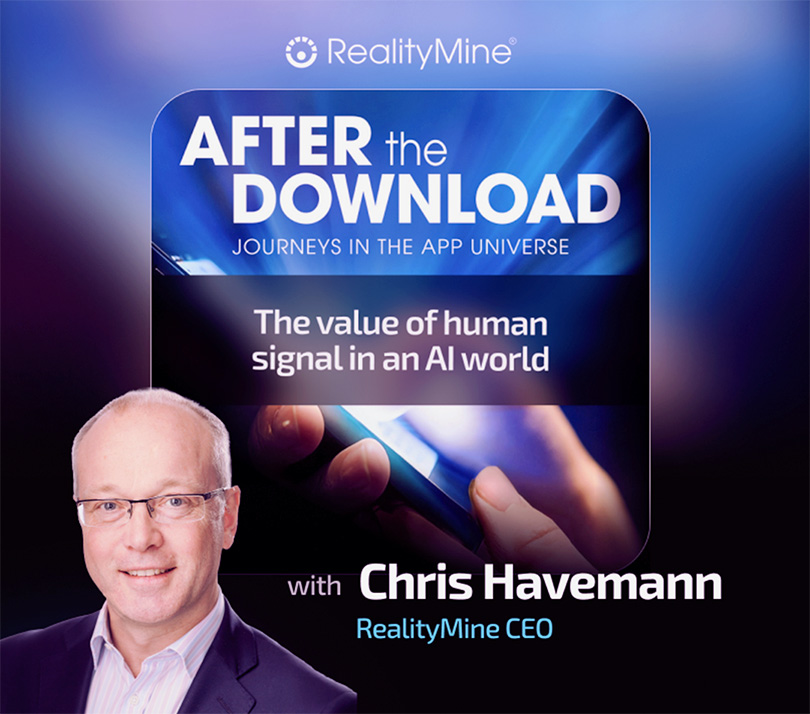
Consumer panels offer critical and convenient access to everyday people — but they have also faced significant challenges in the past decade, from declining response rates to bots and hyperactive respondents. As Chris Havemann says in our latest “After the Download” podcast, panels have reached an inflection point — with AI offering opportunities, but also posing challenges.
Chris Havemann has spent 25 years building businesses around panels. In the early 2000s he co-founded Research Now, one of the largest online panel businesses of its era, running thousands of market research projects a year across more than 40 countries. Today, he's CEO of RealityMine, which partners with consented panels to capture behavioral data directly from participants' devices.
In the episode, Chris walks through what panels are, why the last 10 to 15 years have been difficult for the panel industry, and why he believes AI changes the story completely.
Here's what that shift means for panel owners, and for the wider insights industry.
Panels aren't new. Long before online research, market researchers relied on random sampling: picking consumers at random and asking them about voting intentions, products, or ad campaigns. The arrival of the internet gave rise to the online panel industry — pools of people who signed up to complete surveys in exchange for incentives. Those panels have underpinned consumer market research, TV ratings (Nielsen, BARB), and B2B research (IT decision-makers, healthcare professionals) for the better part of 30 years.
But the last 10 to 15 years have taken a toll. Response rates have declined. Prices have fallen as the category commoditized. A lot of the industry now resells other providers' capacity rather than owning proprietary panels, and “router” technology has turned panels into supply-and-demand marketplaces. Fraud has grown alongside it — cheap labor and bots filling in surveys purely to collect incentives.
Five to ten years ago, panels were “almost going out of fashion,” in Chris's words. Big data was the more exciting story: why survey people about what they watch when a broadcaster's own platform data tells you directly? The assumption was that better modeling on big data would keep shrinking the need for panels.
Underneath the survey and panel business sits a durable idea: a relatively small number of people can be extrapolated to represent a much larger population. A couple of thousand people can predict how a country will vote. A properly designed sample of 500 can potentially power very robust insight.
Chris sees the same logic showing up in AI.
“A relatively small sample of people may be enough to build a very good model that AI can use to activate or drive machine learning.”
In his view, that's the glimmer of hope for a panel industry that's been fighting for relevance: panels can become a source of training data for the AI economy.
Not all training data is equal. Survey and qualitative data — what people say they think — still has a role, and qualitative data can now be captured at scale (focus groups or interviews conducted over online video, for instance). But the data set RealityMine is built around is behavioral: what people actually do across apps, devices, and platforms, including how they discover products, respond to advertising, use LLMs like ChatGPT and Claude, and increasingly hand decisions to agents acting on their behalf.
“We can think of panelists in this digital world as a form of pure human signal.”
It's a way to trace the real path from influence to decision, rather than relying on what people report after the fact.
If panels are going to be trusted training data, Chris thinks the industry will consolidate around fewer, higher-quality panels rather than more of them. The differentiator is provenance: being able to trace a model's output back to the exact source data, how it was captured, and under what consent.
That matters because AI models need fresh data as behavior and trends shift, and “AI slop” — low-quality, unrepresentative, or synthetic data — is a real risk as models run short of genuinely new material to learn from.
“Panels are one form of true human data that can stay fresh — provided you've got good quality input data.”
It's also why RealityMine describes itself as symbiotic with panels: its behavioral data capture technology is deployed on consented panels, under GDPR and other data protection standards, leveraging rather than replacing the panel relationship.
For panel owners trying to capture this opportunity, Chris's advice is directional rather than prescriptive: dial down reliance on ad hoc survey work, and dial up new forms of data capture — behavioral or otherwise — built on high-quality, consented relationships with real people.
The goal, as he puts it, is to become a dynamic input into the AI economy rather than — his words —
“An input into a PowerPoint deck that sits on the table, takes six weeks to get reviewed, and doesn't get activated.”
Panels are one piece of a much larger question. Chris points back to his Research Now days, when the market research industry was valued at roughly $40 billion, split roughly evenly between measurement (what people watch, listen to, buy) and survey-based work (attitudinal research, customer experience). Even the term “insights” is starting to feel dated, he argues, in a world where machines are increasingly ingesting data and acting on it in real time — ad serving, agentic behavior, and micro-decisions happening continuously rather than in a quarterly report.
Chris frames the challenge for every business in the sector as two questions.
“What is my source of proprietary signal? Do I have one?”
And once you have it:
“It's no longer about dashboards, let alone PowerPoint reports. It's about weaving the data into the enterprise at scale.”
Chris closed the episode with an open invitation to listeners — market researchers and non-researchers alike — to share their own view on where panels, and the wider insights industry, go from here.
After the Download is hosted by RealityMine CEO Chris Havemann. New episodes explore how consumer behavior is changing in the digital economy — and what that means for the businesses competing for attention and share.
Listen to Episode 7 on Apple Podcasts | Spotify
RealityMine® captures real-world behavioral data across apps, devices, and platforms — passively, and always with consent.


Featured